

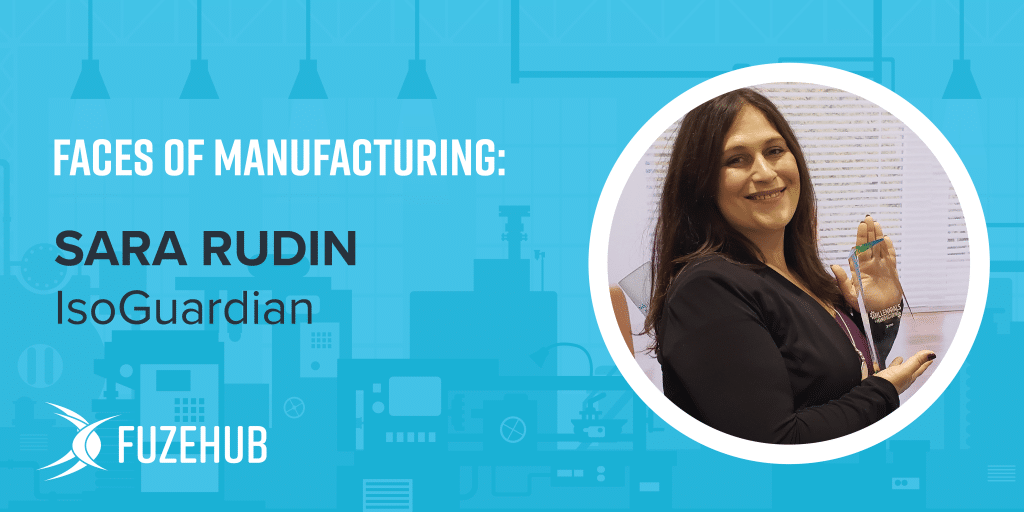
When COVID-19 disrupted the supply chain for personal protective equipment (PPE), manufacturers across New York State were ready to help. Few, however, matched the tenacity and resilience of Sara Rudin, the founder of IsoGuardian. Today, this Capital Region startup continues to define what medical isolation gowns can and should be
Rudin’s career didn’t start in the medical sector. When the pandemic began, she was manufacturing a hemp-blend fabric diaper that Sandy Beck, her mother and the founder of Tidy Tots Diapers, had invented. But when New York State issued a call for help, Rudin answered. What she saw shocked her. Materials that were used as PPE “didn’t look to me like they should work as PPE,” she recalls.
This sparked her deeper investigation into the market for medical isolation gowns, protective garments worn by healthcare workers to prevent exposure to fluids, droplets, and contaminants during patient care. These gowns are made from fluid-resistant or fluid-impermeable materials, come in disposable and reusable forms, and are classified by performance levels.
As people around the world grappled with gravest pandemic since the “Spanish flu” of 1918 – 1920, Rudin learned that medical isolation gowns had remained largely unchanged since the 1960s. She also discovered a system in crisis – and a market that was ripe for reinvention.
Understanding The Problem
Most disposable gowns are made of thin, non-breathable plastic that’s subject to tearing and causes worker discomfort from overheating. Many of these gowns fail basic performance standards such as AAMI PB70, which evaluates liquid barrier performance. The Emergency Care Research Institute (ECRI), an independent non-profit organization, found that over half the gowns they tested failed.
Later, the ECRI listed isolation gowns as one of the top four hazards in healthcare. Subsequently, Scientific American and Kaiser Health News reported that disposable gowns were leaking 400% to 1400% more fluid than allowed. Rudin studied this research, but she also performed her own in-depth customer discovery through the National Science Foundation’s (NSF) I-Corps program.
Nurses and doctors told her how they felt unsafe. One said they’d “rather be wearing a garbage bag” than their hospital-issued gown. Nearly 90% of registered nurses are women, but most isolation gowns were designed for men. Ill-fitting gowns are uncomfortable, but they’re also less effective for protection. Plus, the thin plastic that’s used requires disposal, a cost that hospitals would prefer to avoid.
Creating a better gown wasn’t just an opportunity. It was also a responsibility. Drawing upon her experience with textiles, Rudin adapted Tidy Tots’ diaper material into a reusable, breathable, lab-certified isolation gown that can withstand 300 industrial washes. “IsoGuardian is a revolutionary product redefining safety, savings, and comfort for medical professionals,” she explains.
Overcoming Adversity and Getting “Explosive” Results
IsoGuardian’s early days weren’t exactly easy. The company contended with a fraudulent lease and a landlord who didn’t really own the building. There were also a series of unfortunate events, including a catastrophic roof failure that flooded the facility, destroying equipment and inventory. Pipes froze. The county condemned the building and locked its doors. Rudin’s team couldn’t even recover their materials. “COVID was a nightmare,” she says.
Yet amid the chaos, she secured small grants, refined her manufacturing process, and developed a proprietary three‑step seam‑construction method. The seam is so advanced that the machine needed to make it doesn’t exist yet. IsoGuardian has since filed patents on both the seam and the process. In overcoming adversity, the company also forged valuable relationships.
After its early struggles, IsoGuardian found a home at the STEAM Garden, a business incubator in Albany, New York with maker spaces. The company also became part of the incubator at Albany Medical Center. There, IsoGuardian learned to navigate the complexities of entering a regulated medical market. A two-week clinical pilot provided what Rudin calls “explosive” results.
IsoGuardian collected 148 surveys about its isolation gown across four departments at Albany Medical Center. Nearly all the respondents said they felt safe while wearing it. Moreover, 91% said the gown was easy to use and 88% said it was comfortable. The strong, positive feedback from the pilot study led to IsoGuardian and Albany Med to bypass the second pilot phase and move towards conversations about potential use on a larger scale.
Connecting with FuzeHub to Scale Growth
IsoGuardian also connected with FuzeHub, the statewide center for the New York Manufacturing Extension Partnership (NY MEP). In 2024, the company participated in FuzeHub’s prestigious Commercialization Competition, which is part of the Jeff Lawrence Innovation Fund. IsoGuardian was awarded $50,000 to scale production and bring its medical isolation gown to market.
In the United States, the market for reusable gowns is valued at over $2B. At FuzeHub’s Commercialization Competition, the judges were impressed by how IsoGuardian’s gown combined a substantial cost savings with superior safety and environmental responsibility. Healthcare providers want innovative solutions, but the startups that create them also need assistance.
“I am a solo entrepreneur,” Rudin explained. “I move mountains, but I would be nowhere without community support – and especially FuzeHub.”
A Gown That Performs Where Others Fail
IsoGuardian’s performance data proves the value of its solution. For example, the gown’s rated water penetration is 0.01 g. That’s time times better than the 0.1 g minimum. Competing reusable gowns can withstand ~1 pound of hydrostatic pressure, but the IsoGuardian gown withstands a whopping 67+ pounds of pressure. It has significantly greater tear and burst strength and is also breathable.
Hospital purchasing departments like the return on investment (ROI). An IsoGuardian gown costs $45, but it lasts for 300 uses. That makes the all in per-use cost just $0.38 to $0.88, depending on the laundering method. By contrast, single-use disposable plastic gowns of the same level cost $1.46 to $2.97 each. For a large hospital system using 60,000 gowns per month, the savings can exceed $100,000 monthly.
The environmental impact is also dramatic. A single IsoGuardian gown can replace 300 disposable plastic products. Over the course of five years, this reduces hospital waste by 65,000 tons. To put that amount in perspective, consider that this projected waste reduction is equivalent to 289 Statues of Liberty by weight and volume.
That’s an appropriate analogy for the Empire State, and Rudin seeks to supply most of New York State’s medical isolation gowns within the next two years. Long-term, she envisions expanding the business into Level 4 gowns, the highest level of protective apparel for healthcare professionals. IsoGuardian is also aiming for FDA Class II medical device compliance for using the gown in surgery.
“We’re laying the foundation of a house we think is going to be massive and long‑standing,” she explains. “It’s not just about today—it’s about tomorrow.”
1 thought on “Faces of Manufacturing: Sara Rudin of IsoGuardian”
Congratulations Sara. I saw it down and it’s fantastic. Wishing you all the luck in the world.