

Manufacturers are navigating a perfect storm of pressures: labor shortages, rising production costs, tighter quality requirements, and a constant push for greater throughput. Automation is no longer something you can keep putting off. It’s a necessity if you want to compete and win.
When a small-to-medium sized manufacturer decides to automate operations, there’s an important question to ask and answer. What type of automation is the best fit? For many companies, the choice looks like a fork in the road.
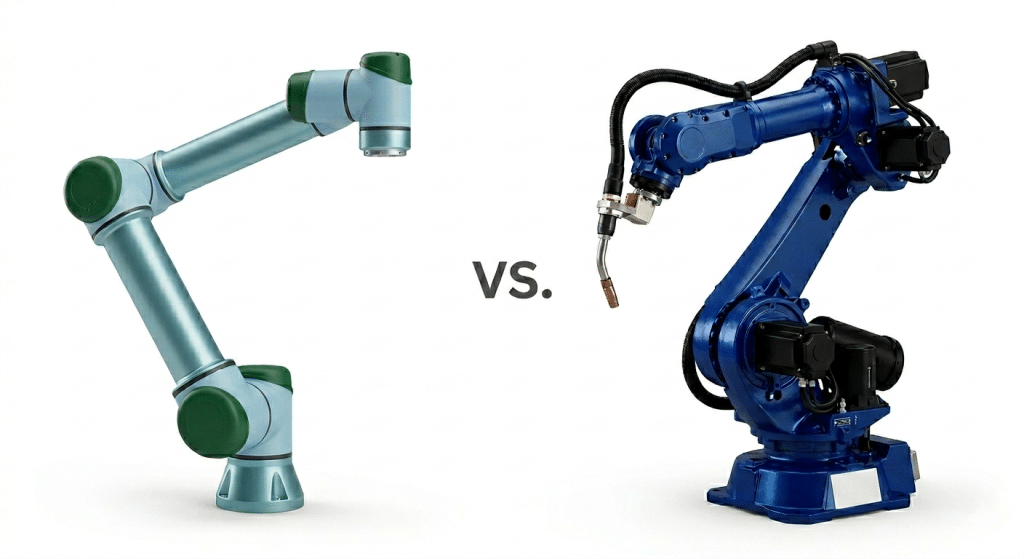
One path takes you to collaborative robots, or cobots. They’re flexible, easy-to-deploy, and are designed to work safely beside people. The other path is traditional industrial automation. It’s built for speed, precision, and high-volume output.
Both can transform a production line, but they solve different problems and require different levels of commitment. This article from FuzeHub is designed to help guide your decision making, and we encourage you to contact our Manufacturer Solutions Program to discuss your specific situation.
The Case for Cobots
Collaborative robots have surged in popularity because they lower the barrier to entry for automation. They’re designed to be approachable – literally. Cobots are lighter and slower than traditional automation, but they’re equipped with force‑limiting joints and sensors that allow them to operate safely near human workers.
For manufacturers with high‑mix, low‑volume production, this flexibility can be a game‑changer. For example, a cobot can tend a CNC machine in the morning and pack finished parts in the afternoon. Often, programming is performed through hand‑guiding or teach pendants. That means you don’t need a full-time robotics specialist to keep a cobot running.
Do you need automation that can be installed quickly, adapted easily, or operated safely in a tight space? Then a cobot might be a practical and cost‑effective investment. They aren’t built for speed, but cobots excel at consistency, reliability, and filling labor gaps that are hard-to-staff. Plus, they’re a great choice for ergonomically risky operations.
Where Traditional Automation Wins
Traditional industrial automation remains the backbone of high‑volume manufacturing. That’s because systems like six-axis industrial robots are engineered for speed, payload capacity, and precision. They require cages, machine guarding, and more complex integration, but they can provide unmatched throughput in return.
Does your plan run the same part or product for years at a time? Is cycle-time the main driver of your profitability? Then a traditional robot is probably a better investment. Industrial robots can lift hundreds of pounds and repeat the same motion with near‑perfect accuracy. Plus, they integrate into automated work cells with conveyors, vision systems, and computer-controlled tooling.
For stamping, injection molding, palletizing, welding, and other heavy‑duty industrial applications, traditional automation is still the gold standard. The upfront costs are higher, and deployment takes longer, but the long‑term return on investment (ROI) is often better for stable, high‑volume operations.
Finding the Right Fit
Cobots vs. traditional automation doesn’t have to be an either/or decision. In fact, many manufacturers use both. Cobots handle the flexible, operator‑adjacent tasks that benefit from human oversight, while traditional robots handle the high‑volume, high‑speed parts of the line. You need the right tool for the job, and automation can be a layered strategy instead of a single decision.
As automation continues to evolve, the question isn’t whether to automate, but how to do it in a way that aligns with your production mix, workforce strategy, and long‑term goals. Whether you choose cobots, traditional automation, or a hybrid approach, the right solution is the one that helps your plant run safer, faster, and more competitively in a demanding manufacturing landscape.
As the statewide New York Manufacturing Extension Partnership (NYMEP) center, FuzeHub can put you in touch with automation experts who are ready to help. Don’t wait to take the first step. Request a consultation with our Manufacturer Solutions Program today.
1 thought on “Cobots vs. Traditional Automation: Which Makes Sense for Your Plant?”
One of the things I appreciated most about “Cobots vs. Traditional Automation: Which Makes Sense for Your Plant?” is that it doesn’t present automation as a one-size-fits-all solution. The comparison between cobots and traditional automation based on production needs, flexibility, and ROI was especially helpful for manufacturers evaluating their options.
While reading, I was reminded of how “AI agents” are creating a similar shift in software automation by enabling systems to make context-aware decisions rather than simply following predefined rules. I recently came across this comparison that explains the concept well: “https://www.linkedin.com/pulse/ai-agents-vs-traditional-automation-understanding-key-zerkc/”.
It would be interesting to hear your perspective on whether AI-driven decision-making could eventually work alongside cobots to create even smarter and more adaptive manufacturing environments.