

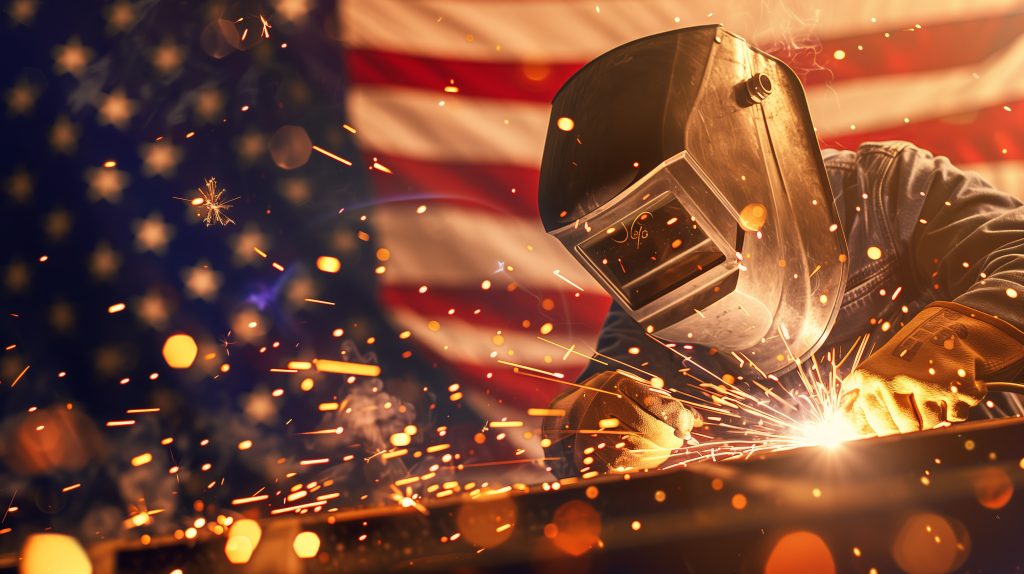
New York State’s manufacturing legacy didn’t begin with the Erie Canal, the New York Central railroad, or the rise of industrial giants like General Electric. Rather, it began during the America’s fight for independence. The Great Chain Across the Hudson, a 75-ton iron barrier forged in Orange County, stopped British warships from sailing upriver and splitting the young United States in two.
The Great Chain was more than metal. It was strategy. And it was proof that American industry, strengthened by New York State’s contributions, could rise to meet the toughest challenges.
Sterling Iron Works: A Forge for Freedom
The Great Chain was manufactured in 1778 at Sterling Iron Works, a foundry and mining complex located in what is now Orange County, New York. At the time, Sterling was one of the finest ironworks in the United States and regularly supplied the Continental Army with cannons, anchors, and heavy forgings.
Forging, a manufacturing process that shapes metal by pressing, pounding, or squeezing it under extreme compressive forces, offers mechanical and physical advantages for high-durability components. Unliked metal machining, which was just beginning in Europe at the time, forging aligns and compresses the metal’s natural grain flow instead of cutting through its internal structure.
Made in New York
When General George Washington, acting upon a recommendation by New York Governor George Clinton, commissioned the construction of a massive defensive chain, Sterling Iron Works delivered. The final product was extraordinary. The Great Chain was over 600 yards long and contained links weighing between 100 to 180 pounds each.
Forging each link required heating wrought iron bars in charcoal-fired furnaces, pounding them into shape by hand, and welding them shut with powerful hammer blows. Sterling’s blacksmiths worked relentlessly and often produced two full links per hour, an astonishing feat given the technology of the era. Today, forging typically relies on hydraulic equipment instead of muscle power.
From The Hudson Highlands to the Hudson River
Metal for the Great Chain was mined locally. Sterling Iron Works sourced its ore from deposits in the Hudson Highlands, a region rich in magnetite – a mineral with high iron content. New York’s natural resources and manufacturing infrastructure were inseparable, and without both the project would not have succeeded. Transporting and installing the Great Chain was also a great achievement.
When the forging was finished, it had to be moved nearly 30 miles to West Point, where the Hudson River narrowed and made a sharp bend. Workers loaded the massive links onto ox-drawn wagons, which reached the river only after traversing rugged terrain. From there, the chain was floated on rafts to West Point, where it was stretched across the river using log booms and anchors.
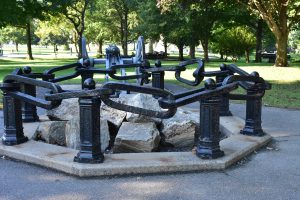
Britain’s Royal Navy, then the largest and most powerful navy in the world, never even dared to break the Great Chain Across the Hudson. After the war, this manufacturing marvel was removed and a portion preserved for historical purposes. The Sterling Iron Works continued operation but eventually closed in 1842 when faced with stiff competition from large steel mills.
Small-to-Medium Manufacturing Can Win
If the Sterling Iron Works were alive today, the New York Manufacturing Extension Partnership (NY MEP) could surely have helped. This state and federally funded network is designed to help small and mid-sized manufacturers become more competitive. The Council of Industry, which is now the regional NY MEP center for the mid-Hudson Valley, has been assisting manufacturers since 1910.
Much has changed in America’s 250-year history, but the vitally important role of small-to-medium manufacturers remains. If your business is looking for assistance with modernization and innovation, request a no-cost 30-minute consultation with FuzeHub’s Manufacturer Solutions Program. They can connect you to your regional NY MEP center and to a vast array of manufacturing resources.