

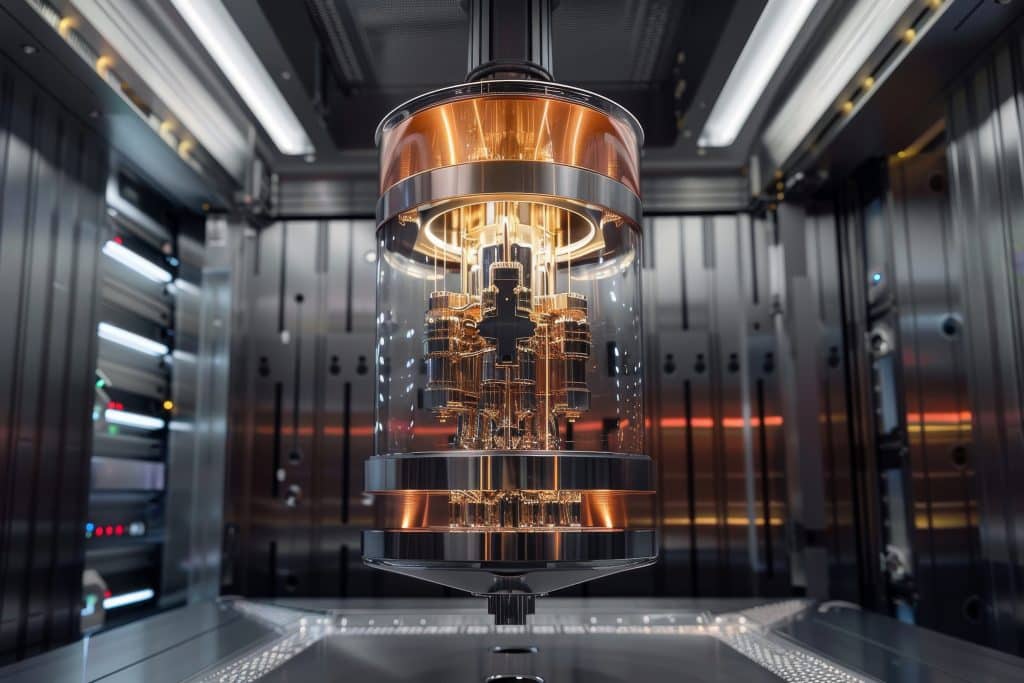
Quantum computing is an emerging technology that excites computer scientists and confounds manufacturers. It seems abstract, theoretical, and far-removed from the realities of production, logistics, and materials engineering. Yet quantum computing isn’t science fiction. This early and evolving discipline will eventually reshape industries that depend on process optimization, physical simulation, and complex decision-making.
This article distills an in-depth interview with Dr. Satyavolu “Pops” Papa Rao, Senior Director of Emerging Technologies and Research at NY Creates in Albany, New York. Pops holds a Ph.D. in Materials Science & Engineering from the Massachusetts Institute of Technology and leads work on fabrication of quantum devices at NY Creates, a non-profit organization that owns and operates the Albany NanoTech Complex – North America’s largest, most advanced public-private semiconductor research R&D facility, conducting R&D in areas ranging from semiconductors, quantum technologies, advanced memory, integrated photonics, devices for neuromorphic computing and AI, advanced packaging and Heterogeneous Integration (HI), and more.
The goals for this article are simple: explain what quantum computing is, why it matters, and where it might realistically impact manufacturing in the coming decade. FuzeHub would like to thank Pops for making this possible.
What Makes Quantum Computing Different?
To understand quantum computing, it helps to start with how today’s computers work. Classical computers, as they’re known, use transistors to process data as binary digits (bits). In turn, each bit is set to either 0 (off) or 1 (on) to align with the physical, two-state nature of electronic hardware. From CNC controllers to shop floor PCs, today’s digital devices depend on this binary system.
Quantum computers use quantum bits (qubits) instead. Unlike classical bits, qubits can exist in multiple states. In other words, qubits can exist not just as 0s or 1s, but also as a mixture of both. “A coin toss provides an analogy,” Pops says. A coin lying flat is like a classical bit with heads (0) on one side and or tails (1) on the other. A coin spinning in the air is temporarily both heads and tails.
That’s also a good way to visualize superposition, a principle of quantum mechanics that describes how subatomic particles like electrons can exist in multiple states or locations simultaneously. Quantum computers also use quantum entanglement, a phenomenon where two qubits become linked so tightly that changing one instantly affects the other, regardless of space. “These two qubits are joined together as one entangled object.” Pops explains, “even if they’re far apart.”
Why is Quantum Computing a Breakthrough?
Superposition and entanglement give quantum computing its power and access to much greater computational capabilities. That’s why these computers have the potential to solve certain problems far more quickly than classical systems. Yet quantum computing isn’t “faster” in the traditional sense. Rather, it’s a fundamentally different way of processing information that still involves algorithms: sequences of rules or instructions for solving a problem or completing a task.
Quantum computing’s most famous algorithm is Shor’s algorithm, which can factor very large numbers exponentially faster than classical computers. Shor’s algorithm matters because today’s encryption techniques depend on how classical computers would need millions of years to crack the encryption. Other quantum algorithms offer polynomial speedups, computational improvements with potential applications such as logistics resource and financial portfolio risk optimization or the modeling of physical processes.
Quantum Computing Today: Real Machines, Real Progress
Quantum computing is not hypothetical. In fact, there’s a machine in the Capital Region. Rensselaer Polytechnic Institute (RPI) in Troy, New York, has an IBM Q System One. IBM debuted the world’s first integrated quantum system for commercial and scientific use at the CES Show back in 2019. But that doesn’t mean this technology is ready to solve the thorniest problems facing small-to-medium manufacturers.
“It’s been said that people always underestimate the impact of technology in the long term and overestimate it over the near term,” Pops notes. Today, IBM is joined by Google, and a host of smaller players and startups who are advancing competing quantum technologies. There isn’t a clear winner yet, but the impact in the next decade or two could be profound. Just as silicon carbide (SiC) was once a niche research topic, SiC semiconductors now power electric vehicles and LED lighting.
Where Quantum Computing Could Impact Manufacturing
There are four principal areas where quantum computing could eventually improve manufacturing:
- Process optimization
- Fluid dynamics and aerodynamics
- Materials discovery and simulation
- Energy efficiency
Quantum computers are well-suited to solving optimization problems because they can explore many possible solutions simultaneously. That’s why Wall Street firms are using them to explore portfolio optimization. For example, Goldman Sachs has developed and deployed quantum algorithms that could allow the firm to price financial instruments at quantum speeds. In financial markets, computing speed is a tremendous advantage.
Someday, small-to-medium manufacturers could use quantum computers to solve problems such as how to route parts, schedule production, minimize downtime, and allocate limited resources. Simulating fluid flow is another potential application. Aerospace, automotive, turbomachinery, chemical processing, and semiconductor crystal manufacturers could all benefit since even small improvements in simulation accuracy can lead to major gains in performance and efficiency.
Materials discovery and simulation may be the most transformative long-term application. Quantum computers are inherently suited to simulating things like the behavior of electrons in materials. That could accelerate the discovery of new alloys and high-performance polymers. It could also lead to stronger composites, better magnets, more efficient catalysts, and advanced battery chemistries. “You need a quantum computer in order to simulate nature,” Pops explains.
Today’s quantum computers are too small to simulate anything beyond simple molecules like water and lithium hydride, but there’s steady progress on multiple fronts. That includes reducing the energy footprint of data centers that use artificial intelligence (AI) for applications like automation and simulation. Pops cautions against the “hype” surrounding quantum computing, but he foresees advances that could help manufacturers of all sizes in the 10 years.
What Can Manufacturers Expect in the Next Decade?
There are three main areas were manufacturers can expect to see progress in the shorter-term.
- Early quantum-inspired optimization tools that run on classical computing hardware but borrow ideas from quantum algorithms.
- Hybrid-quantum-classical workflows where certain steps of a simulation or optimization problem are offloaded to small quantum processors.
- Improvements in materials R&D pipelines that use quantum-enhanced simulation.
There are also three areas where major advances won’t happen in the next decade.
- Fully quantum-driven factories
- Large-scale materials simulation
- Real-time quantum control of manufacturing equipment
“Those require systems that are larger and more stable than what exists today,” Pops says. “The most likely future,” he adds, “are hybrid systems that combine multiple qubit types for functions such as memory, communication, or computation.”
What Should Manufacturers Do Now?
Quantum computing isn’t ready for prime-time, but manufacturers who wait to start learning, experimenting, and preparing risk falling behind the competition. “Now is the time to build internal expertise,” Pops suggests. Practical steps include:
- Identifying optimization problems that could benefit from quantum approaches
- Partnering with R&D centers, universities, or national labs
- Exploring quantum‑inspired algorithms
- Training engineers in quantum fundamentals
- Monitoring developments in materials simulation
Quantum computing may never replace classical computing, but examining a new tool that will eventually sit alongside today’s systems could give you an edge.