

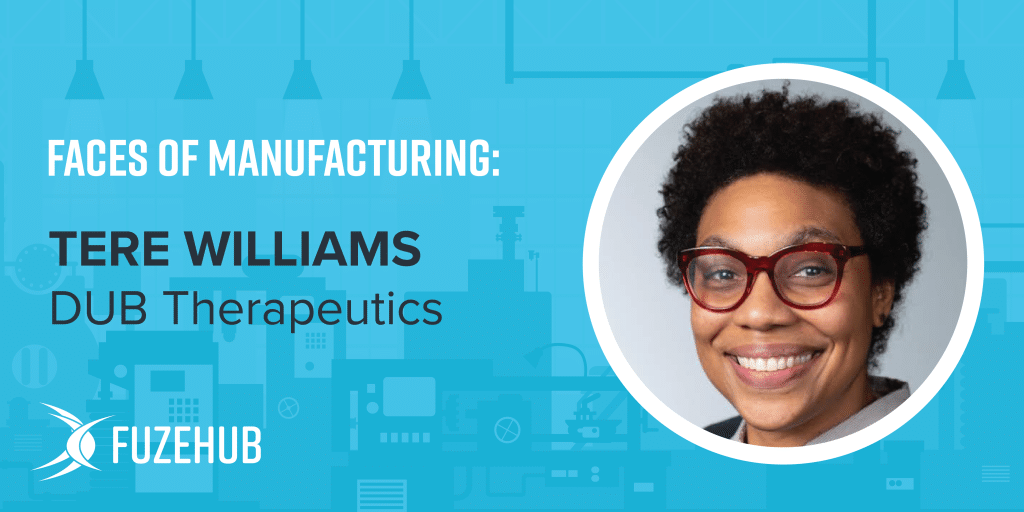
Tere Williams is the co-founder and CEO of DUB Therapeutics, a Syracuse, New York biotech startup that’s developing treatments to prevent fibrosis – the formation of excessive scar tissue. Some scars are treated for cosmetic reasons, but fibrosis can prevent organs from working properly. That includes the human eye, the initial focus of the company’s efforts.
DUB Therapeutics is developing small interfering RNA (siRNA) that stop the production of disease-causing proteins. For fibrosis that involves scarring of the cornea, this could dramatically simplify treatment—and preserve vision. It’s a significant reason the company won a $50,000 Commercial Competition award from FuzeHub in 2023.
A Founder’s Journey
Tere Williams’ personal and professional journey demonstrates a breadth of vision. A Virginia Tech alumna, she was drafted in 2001 by the Women’s National Basketball Association (WNBA). Later, she moved to Montreal, Canada, where she sang in jazz bands. After returning to the United States, she volunteered in a lab centered on regenerative medicine at Boston University.
The hours spent within that laboratory ecosystem reignited her scientific interest. That led to completion of her undergraduate degree, a 2-year NIH-funded research training program, and, later, entering a PhD program at Albert Einstein College of Medicine in the Bronx. During COVID, she realized a career in academia wasn’t her long-term goal and started SPK Consulting, a life-science consultancy that quickly gained traction.
A colleague then introduced her to Dr. Audrey Bernstein, a corneal biology expert at SUNY Upstate Medical University in Syracuse. Dr. Bernstein had invented a promising siRNA technology but needed someone with immunology expertise, business acumen, and the ability to commercialize a therapeutic platform. Williams was well-suited for the role.
She decided to help—with the agreed-upon first step of teaching the lab how to work with mice and develop murine immunology assays for more mechanistic research. Later, she co-founded DUB Therapeutics in March 2022 to further develop the technology. Her motivation was both scientific and personal. Her father, a police officer, had died from a rare fibrotic heart condition in 2014. Williams also understood how rare it was for someone who looked like her to be asked to lead a venture of this scale.
“I knew I had the skills, the curiosity, and the tenacity,” she says. “Most importantly, I knew this technology deserved a chance to reach patients.”
The Problem: Scarring That Steals Sight
Fibrosis, the excessive build-up of tough, fibrous connective tissue, typically occurs as a healing response to repeated injury or chronic inflammation. Over time, however, excess scar tissue can stiffen organs and impair their normal function. In the human eye, scarring of the cornea from injuries, infections, or inflammation can cause severe vision loss.
Current treatments for fibrosis often require six doses of anti-inflammatory eye drops for months. Many patients rely on steroids that carry long‑term risks, and there is no FDA-approved drug that directly addresses corneal fibrosis. As the eye’s primary focusing element, the cornea is critical because it bends incoming light to form clear images on the retina.
Scarring in the retina prevents those signals from being received and prevents clear images from being stitched together in regions of the brain. Vision impairment, and more severe blindness, is a major indicator of morbidity. Not only are patients more at risk of falls and accidental prone deaths, but patients are less likely to visit clinics for other diseases, less likely to adhere to treatment regimens and have significantly lower quality of life. In short, people who lose their vision have a shortened life-span as a result.
The Technology: Self‑Delivering siRNA
DUB Therapeutics’ technology uses synthetic siRNA with a lipid attachment to enter cells without viral vectors or nanoparticle carriers. This “self‑delivery” mechanism reduces the risk of toxicity and its room-temperature stability improves logistics and simplifies manufacturing. No bacterial or cellular systems are required, and the platform is more scalable and less expensive than biologics.
Importantly, its long-acting performance supports once-per-treatment/one-two dose treatment dosing regimens instead of multiple daily applications. For patients who treat their eyes six times a day for durations lasting three months, the technology could be life-changing. A partnership with Nitto Denko Avecia, a global leader in siRNA manufacturing, is advancing substance development and scale ahead of clinical trials.
Together, DUB Therapeutics and its contract manufacturer have scaled research-grade material and completed GLP manufacturing. DUB Therapeautics is now preparing for GMP production ahead of dosing the first patient(s). Good Laboratory Practice (GLP) refers to the standards used before human trials. Good Manufacturing Practice (GMP) applies to clinical-grade and commercial-grade drug manufacturing.
DUB Therapeutics’ first clinical target is corneal fibrosis, but its technology has broad potential. Through academic collaborations, the company is exploring proof-of-concept data for other corneal surface diseases, retinal fibrotic disease, neurodegeneration, and systemic fibrosis—kidney fibrosis, liver fibrosis, and other fibrotic conditions. While the basic science is still fascinating, if academic collaborators generate compelling data that have commercial potential, DUB Therapeutics reserves the right for further developing those opportunities.
Customer Discovery, Market Validation, and Funding
To determine whether its technology had commercial potential, DUB Therapeutics completed regional and national NSF I‑Corps programs as part of its own early-stage diligence. This involved conducting more than 125 required interviews as part of program participation for the combined programs for customer discovery across the “three Ps”: patients, physicians, and payers (insurance companies). Physicians expressed, and continue to have, strong enthusiasm for the technology— as did the innovation ecosystem.
The year 2023 was pivotal. Within a three-month span, DUB Therapeutics become a finalist and winner of the FuzeHub Commercialization Competition, won the SUNY Startup Summer School (S4) Demo Day, secured a $1.8 million federal grant, and was accepted into the Nucleate Global Virtual Activator. The FuzeHub award played a key role in elevating the company’s visibility.
“It raised our profile,” Williams explains. “It signaled that our technology – and our team – were worth paying attention to.”
Looking Ahead
DUB Therapeutics is currently preparing for clinical trials, expanding its partnerships, and continuing to build momentum in New York State’s growing RNA therapeutics landscape. With a technology that’s safer, simpler, and more scalable than existing siRNA approaches, the company is positioned to make a meaningful impact on how fibrosis is treated—starting with the eye.
“There’s no product on the market that addresses the scarring component of ocular diseases sufficiently,” Williams says. “You dose once and, in that single treatment get the standard of care benefits, reduction of inflammation, and the necessary benefits in reduction/prevention of fibrosis and scarring and tissue regeneration that preserves vision. The six-times-a-day regimen is not only not applicable here; its antiquated.”