

Two NYSTAR-supported operations are impacting the universe from the International Space Station (ISS).
TelosAir Inc.—a Clarkson University startup based in Potsdam, N.Y., in collaboration with university researchers and NASA’s Glenn Research Center—has developed the OPto-Electrical Real-time Aerosol sensor (OPERA), a compact, low-power air quality sensor successfully deployed aboard the ISS.
Monitoring air quality in spacecraft is critical to astronaut health and safety. Smoke particles can signal the earliest stages of a fire; biological particles can spread infection during long-duration missions; and future lunar and Martian habitats will need to detect dust that astronauts carry inside from planetary surfaces. And in the microgravity environment of space, large particles can clog the airflow pathways of conventional aerosol sensors and render them unusable within days.
Therefore, NASA needed a compact, quiet, energy-efficient sensor that could operate continuously and reliably amid the microgravity of the ISS.
Led by Professor Suresh Dhaniyala (co-director of Clarkson’s Center for Air and Aquatic Resources Engineering and Science – CAARES), the OPERA sensor was developed using a novel focused light scattering technique, which eliminated the clogging problem of conventional designs and allowed the sensor to be compact, low-power, and quiet — meeting the strict operational constraints of spacecraft.
OPERA has operated on the ISS over the past year, continuously measuring airborne particle concentrations in the station’s microgravity environment, producing one of the first detailed records of particle levels aboard the station. The technology is also being advanced to identify specific particle types—including smoke, biological materials, and lunar dust—in support of future NASA missions to the moon and Mars.
The company has received support from several members of the NYSTAR network, including the Center for Advanced Materials Processing (CAT), Shipley Center for Innovation (Hot Spot), FuzeHub (MEP), and NY Ventures (via Launch NY), as well as funding from NYSERDA for student interns to help with sensor testing and evaluation.
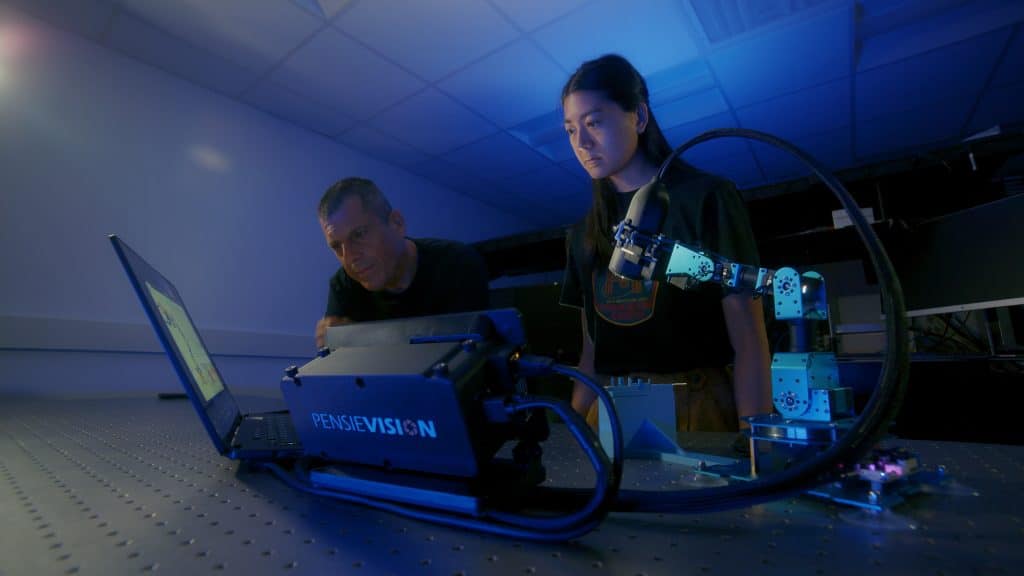
For the Rochester-raised Pensievision, the deep-technology company and first-place winner of Luminate NY Cohort 8 developed a precision imaging platform that combines artificial intelligence with astronomy imaging techniques to generate high-resolution 3D information using a compact, solid-state optical system with no moving mechanical components.
Traditional precision 3D imaging systems often rely on multiple cameras, lasers, structured light, or mechanical scanning. These systems are frequently expensive, bulky, power intensive, and difficult to deploy in harsh environments.
Pensievision’s solution: an AI-powered precision 3D imaging platform that combines artificial intelligence with astronomy imaging techniques to generate high-resolution 3D information using a compact, solid-state optical system with no moving mechanical components.
Thanks to support from Empire State Development through Luminate NY and the broader NYSTAR ecosystem, Pensievision was enabled to accelerate product development, establish its research and development headquarters in Rochester, expand its engineering team, build strategic collaborations with New York universities and international research partners, and propel the company’s flight hardware into successful environmental testing at NASA’s Johnson Space Center.
After further research and testing, the company developed two independent spaceflight payloads. The first imaging system, built for biological research in microgravity, was deployed aboard the ISS. The second system, for autonomous space imaging validation, was installed aboard a CubeSat launched on SpaceX’s Transporter-17 mission.
With two active imaging systems now operating in orbit, Pensievision has demonstrated that technology developed and commercialized in New York can meet the demanding requirements of spaceflight while opening new opportunities in aerospace, advanced manufacturing, and healthcare, with the same platform now being commercialized for precision industrial inspection, minimally invasive endoscopy, cervical cancer screening, and other medical applications.
Thanks to the many NYSTAR centers, hotspots and incubators for submitting their success story. Click here to submit your stories to share with the NYSTAR network— we want to hear from you!