

Medical devices continue to be a bedrock facet of the life sciences industry, empowering researchers, enabling clinical trials, and bringing to life new possibilities for patients and practitioners alike.
As more innovations are needed to improve or bridge gaps in treatment, three New York-based businesses—Epic Airway Systems, GE Healthcare, and Z Beats—are utilizing the collaborative capabilities of the NYSTAR support network to pioneer medical devices, all of which have potential as game changers in the industry.
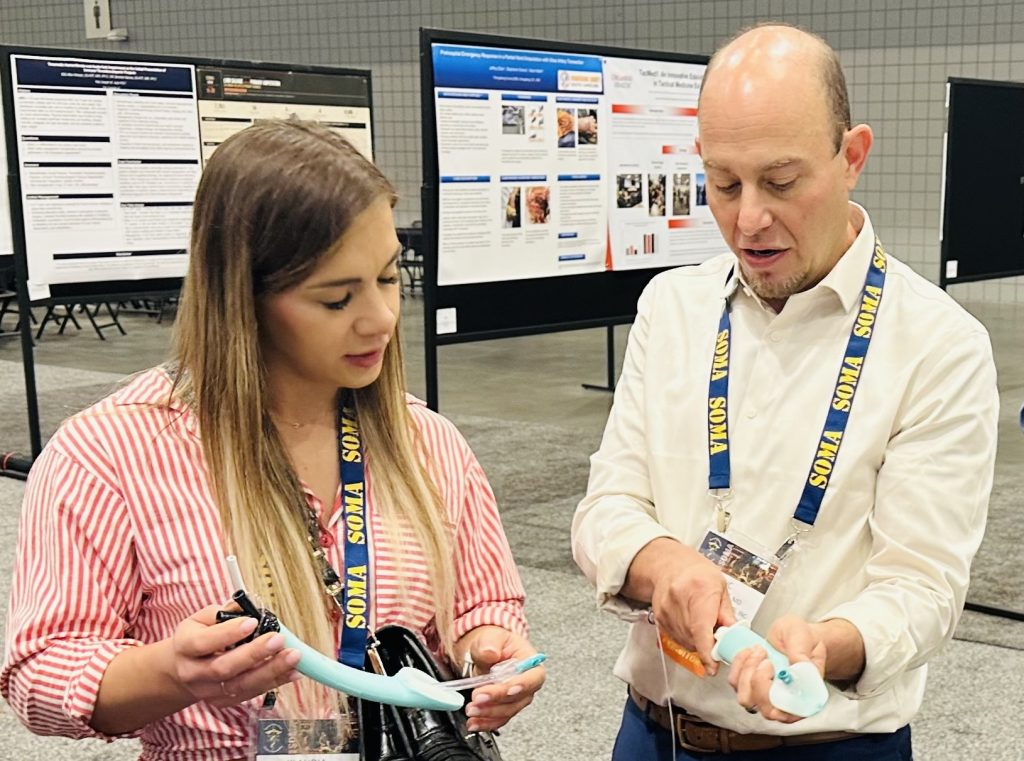
NYC Innovation Hot Spot client Epic Airway Systems (Schenectady) is developing a patented airway management device—focused on improving patient safety and ease of use during emergency airway procedures and surgeries—designed for use by anesthesiologists, CRNAs, emergency medicine physicians, and paramedics.
Founded by former paramedic turned anesthesiologist Eric Moses, Epic Airway Systems identified a longstanding challenge in airway management: healthcare providers are often forced to choose between devices that are easier to use but less secure for patients, or devices that secure the airway but introduce additional risks and complications. Existing solutions—including endotracheal tubes and laryngeal masks—require difficult tradeoffs involving patient safety, provider usability, and procedural efficiency.
Epic’s product eliminates these tradeoffs, creating a surgical asset that combines the advantages of existing airway solutions while reducing complications that have hampered patients and professionals for years.
Since participating in the NYC Innovation Hot Spot and New York NSF I-Corps programming—and finding product development guidance from Fuzehub—Epic Airway Systems has achieved several important commercialization milestones. The company has advanced multiple prototype iterations through testing; secured patents in both the United States and European Union; and earned $50,000 at the 2023 FuzeHub Commercialization Competition during the annual New York State Innovation Summit that has helped validate the company’s commercial potential and increased statewide visibility across the life sciences field.
For GE HealthCare, the company recognized a need for disposable healthcare monitoring devices used in hospitals and clinics to enhance patient monitoring, support infection control practices, and streamline clinical workflow.
However, conventional disposable medical electronics commonly rely on silver-based conductive materials, plastic substrates, and globally concentrated supply chains that are vulnerable to disruptions and material shortages. These systems can also be expensive, generate significant environmental waste (due to their single-use nature), and are often manufactured elsewhere, making them susceptible to possible global supply-chain issues.
To combat these issues, the company has collaborated with researchers at Binghamton University’s FlexMed CAT to develop low-cost and sustainable wearable medical electronics using printed electronics manufacturing technologies.
Supported by NYSTAR infrastructure and the advanced manufacturing capabilities of the FlexMed CAT, the product team was able to develop fully printed ECG electrode lead sets using carbon-based conductive inks printed directly onto paper-based substrates; optimize printing, encapsulation, curing, and thermal compression processes to improve conductivity, flexibility, durability, and manufacturing consistency; and demonstrate that careful design optimization, multi-layer printing, and process improvements can still provide reliable electrical connections and stable bio-signal sensing performance for selected wearable and disposable medical electronics applications.
Finally, the Stony Brook-based ZBeats set out to address a growing challenge in healthcare: the need for faster, more scalable, and more accurate cardiac diagnostics. As demand for ambulatory ECG monitoring has increased, healthcare providers have required innovative medical technology capable of processing large volumes of patient data while maintaining clinical-grade accuracy.
Through sustained and diversified cooperation with multiple NYSTAR assets—including Stony Brook University’s Long Island High Technology Incubator (LITHI), Long Island Manufacturing Extension Partnership (LIMEP), Center of Excellence in Wireless and Information Technology (CEWIT), and Fuzehub—ZBeats has developed ZBPro Diagnostic, an FDA-cleared, cloud-based Software as a Medical Device (SaMD) that analyzes ambulatory ECG recordings and provides clinicians with high-accuracy arrhythmia detection, comprehensive reporting, and clinical decision-support tools.
This continued engagement with the NYSTAR ecosystem has helped ZBeats strengthen its technology, accelerate commercialization, achieve regulatory approval for its FDA-cleared ZBPro platform, and expand customer adoption. Today, the company generates approximately $300,000 in annual revenue while creating and retaining multiple high-level positions at the company.
And like their fellow medical device creators, the work of ZBeats has shown the potential of medical device ingenuity across all of New York—and what the support of the NYSTAR network can do for product development, commercialization, and advancing big ideas forward.
Thanks to the many NYSTAR centers, hotspots and incubators for submitting their success story. Click here to submit your stories to share with the NYSTAR network — we want to hear from you!